

Many poker operators can only take players from one country or one state. Checking the IP address is not enough for that. An IP address can sit in a different place from the player, and a VPN changes it in seconds.
So for an operator that may only serve players inside one US state, we built location checks into our poker platform using Radar as the location verification provider. This post explains how it works, in plain words: what the player sees, what happens at the table, and what the operator sees in the admin.
It runs on web, Android and iOS.
Why IP checks alone are not enough
An IP-only check answers “where does this network appear to be?” The operator needs a different answer: “where is this player physically, right now?”
Radar gives the platform a verified location: the state from the device’s location, how accurate that location is, network information, and risk signals such as VPN use. The platform uses all of these together, not the IP alone.
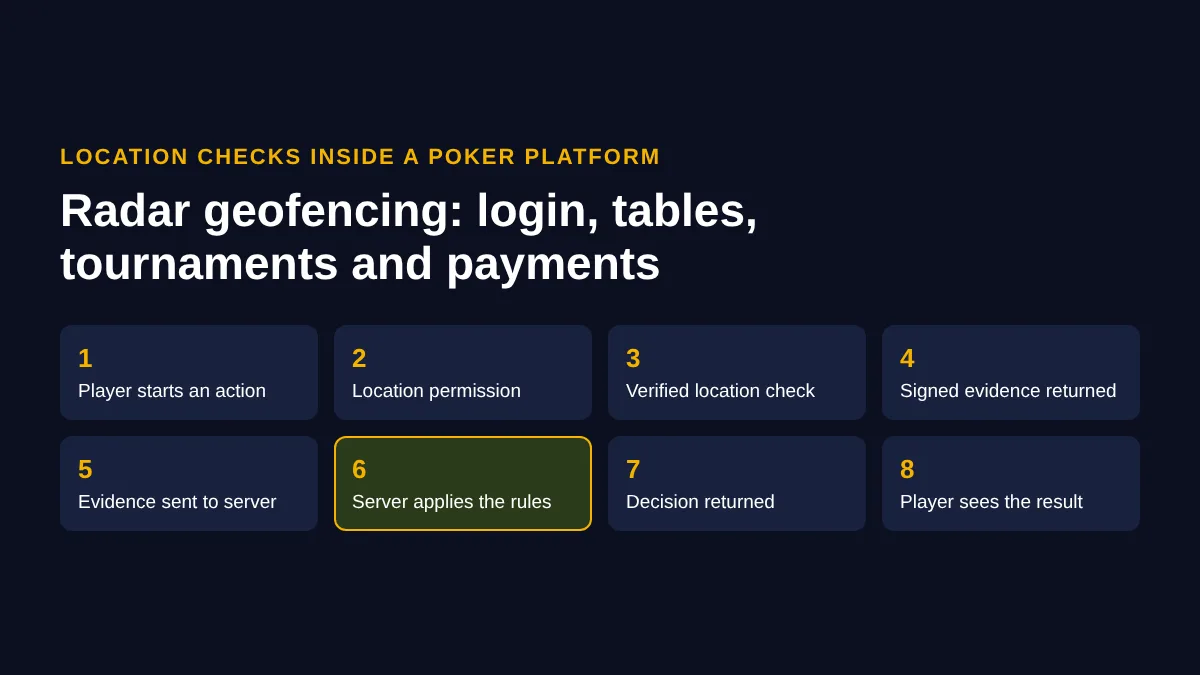
How one location check works
- The player opens the game and starts an action that needs a location check.
- The game asks for location permission if it does not have it.
- Radar runs a verified location check.
- Radar returns signed evidence of that check.
- The game sends this evidence to our server.
- The server validates it and applies the operator’s location rules.
- The server returns the decision.
- The game shows the right screen or message.
The important part is step 6. The server makes the decision, never the game on the player’s device. The game cannot send its own coordinates, a state code or an “I am inside” flag and get in. Only signed evidence counts, and evidence that is missing, expired, wrongly signed or belongs to another player is rejected.
Each check ends in one of three results: allowed, restricted, or allowed but flagged for the operator to review.
Login and signup
The location check comes before login or signup is completed.
- If the player refuses location permission, login stays blocked, and the game explains how to turn it on.
- If the player is outside the allowed area, the game shows a clear message that it is only available in that area.
- Once the player fixes the problem, they press Retry and a fresh check runs.
Location accuracy near a border
A player can be inside the allowed state but very close to the border. If the possible error in their location is larger than their distance to the border, the platform cannot be sure they are inside, so the check fails and the player is asked to turn on GPS or Wi-Fi and try again.
This is a small detail, but it is exactly where simple location checks go wrong.
VPN and risk signals
Along with the location, the platform reads risk signals:
| Signal | What it means |
|---|---|
| VPN or proxy | The network hides or changes where the player appears to be |
| Tor | Traffic routed through the Tor network |
| Mocked location | The device is reporting a faked GPS location |
| Location jump | Movement between two checks that is not realistic |
| Compromised device | Rooted, jailbroken or tampered device or game build |
| Screen sharing | Screen sharing or remote desktop, on platforms that support the check |
Which signals block a player and which only raise a flag is the operator’s own compliance decision. Some signals are review-only by design: for example, when the IP shows one state and the device shows another, or when many accounts use one device. These go to the operator for review and do not block the player on their own.
Checks continue during the session
Passing the check at login does not cover the whole session. The platform checks again:
- at a regular interval the operator can configure
- when the player comes back to the game or the browser tab
- when the network changes
- when the game reconnects to the server
- when the player presses Retry
If no recent successful check exists, the location is treated as out of date and the player must verify again before taking new actions.
What happens in the middle of a hand
This is the part poker makes harder than other games. You cannot simply throw a player out mid-hand: there is money in the pot and other players at the table.
Cash games. If a player leaves the allowed area during a hand, they finish that hand. Then they are removed from the table before the next hand starts, and their chips are returned under the normal leave-table rules. If they are seated but not in a hand, they are removed straight away. They cannot join another table until a new check passes.
Tournaments. The player finishes the current hand. From the next hand they are set to sit out: their chips stay on the table, they are folded automatically, and blinds and antes continue, as in any tournament. Registration, late registration, re-entry, rebuy and add-on are all blocked while they are outside. When they are back inside, they press Retry and then choose Sit In themselves.
If a player is outside the allowed area when a tournament prize is paid, the payout is held for the operator’s compliance review.
Payments get their own check
Being verified in the game is not enough to pay. The payment page is a separate web page, so it runs its own check.
- Level 1: the server checks the player’s current location status before the payment page opens.
- Level 2: the payment page runs a new verified check. The payment form stays disabled until it passes.
When both pass, the server issues a one-time location grant for that payment. The grant belongs to one player and one payment session, works once and expires after a short time. A payment without a valid grant is rejected, and a payment confirmation that arrives without one is held for review.
What the operator sees in the admin
- Geofencing on or off, and the allowed country and state.
- Blocked requests report: every rejected check with time, username, device, reason, location and accuracy, distance to the border and network details. Filters and CSV export.
- Audit log: every check, allowed or rejected, with filters and CSV export.
- Block a user or a device by hand. A blocked player sees a contact-support message and cannot use Retry.
- Location in hand history: for every hand, each player’s last verified location, device and IP are stored for authorized admin staff only. Other players never see it. This helps with disputes and with spotting players at one table who share a device, an IP or a location. These are signs to look into, not proof.
What this means for an operator
- You can run a poker room for one state or one country and show how every player was checked.
- Honest players lose very little: one permission prompt, and a clear message with a Retry button if something fails.
- Your compliance team keeps the decisions: which signals block, which only flag, and when a payout is held.
We build the poker platform and the location checks inside it. We do not hold a gaming licence, and we do not give legal advice: which regions you may serve is a question for your own lawyers.
See it
Location checks work with our white label poker platform and with sweepstakes poker software. The white label platform has no setup fee: $1,000 a month and 9% of rake and tournament fees. See pricing, or book a call and we will show you the location checks on a demo.